Thursday, 15 August 2013

Hirosaki: Fujita memorial garden

A room with a view
The Fujita memorial garden, at the southern end of the castle, was the last port of call in our day in Hirosaki.  It was built in the Taisho era, 1919, by a prominent local industrialist. And, like a lot of similarly statused people of the era, the Fujitas combined Japanese and western styles. Rather than combining it in the one building, like the Kyu Furukawa Teien in Kita Ku Tokyo, the Fujitas built a Japanese building, which looks out over the garden, and a western building that contains a cafe in it today.

The Japanese - kan
 
The imperial seal - I'm curious whether this was a part of the
original design - I guess state Shintoism had taken root by 1919 and
it's possible.
The Fujita family crest
Calligraphy hanging on the wall 
Translation
Calligraphy
The western building
With western furnishings
 
Take stairs down to a garden below
Irises in the garden
 
 
Hiro's nieces were familiar with the garden as a place that
had been used in some TV drama.... 
Not a good photo, but a charming well. When the water
is poured over the rocks there is a musical tinkle as it
falls into a vessel below.
 
Posted by Picasa

Hirosaki Botanical Gardens - a white peacock

Next to the main entry of Hirosaki castle (the southen end)  is a botanic garden.  We figured since we weren't likely to be in Hirosaki again for a while, to take the chance to have a look.   We couldn't stay long, but the white peacock there put on a performance that made it very worthwhile going to.


Beautiful!
 
And a not quite so attractive angle


.
 
Posted by Picasa

Hirosaki castle


The principle tourist attraction of Hirosaki is Hirosaki castle, which was built at the beginning of the Edo era by a loyal retainer from the Osaka area who was allocated land by the shogun after the the Battle of Sekigahara. (he was fortunate to have been allied with the winning side...)
When Hiro's niece saw the bridge, her reaction was red bridges are so Edo era...
It's not something I'd thought about before.
By national standards it's a very modest castle.
Compare with Himeji
http://ponkanchan.blogspot.jp/2010/02/himeji-castle-town.html
But it is an original castle - one of 12 in Japan.
(I had thought it was 8 but googling says 12)
Hirosaki's mascot
THe interior of castles seems to always be samurai armour,
and fighting implements - swords, guns, bullets.
Hirosaki is no exception.
A quick glimpse in the mirror
Hiro's nieces were quite surprised when I told them the reverse manji
often had a strong negative image for western people.   I guess
with Finance Minister Aso saying Japan should learn from the way that
the Nazis introduced changes to the constitution with minimal complaint
suggests it's not very high up in the history syllabus..,
Great attention to detail in the surrounds
Manji manholes
 
Wide moats
Posted by Picasa

Inakadate: Ricefield "Tambo" Art

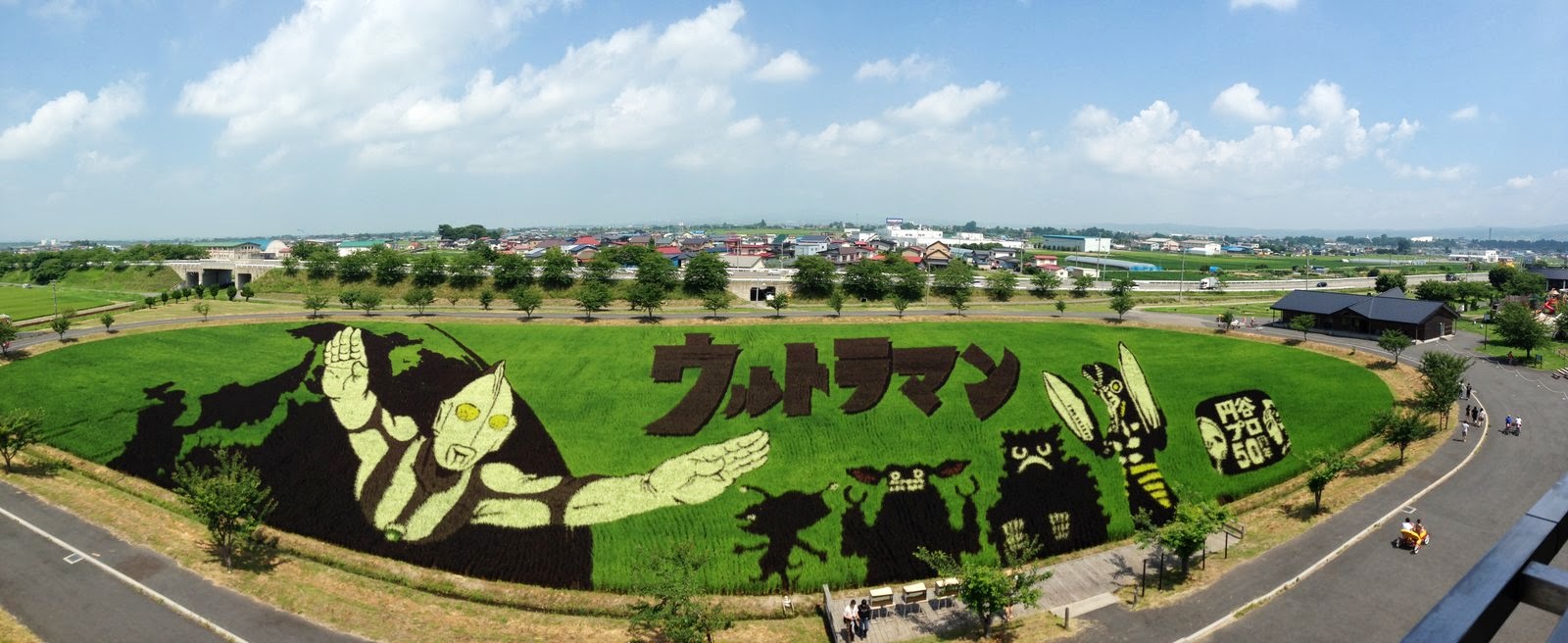
We ventured north to Hirosaki on an outing with Hiro's nieces.  Inakadate has reinvigorated itself through "tambo art"  - art "drawn" with  different colours of planted rice.  Each year they choose a different image.
This year the rice was at two locations, and unlike when I went two years ago, had an entry fee of perhaps $8 an adult.
http://ponkanchan.blogspot.jp/2011/09/rice-field-tanbo-art.html
Ultraman

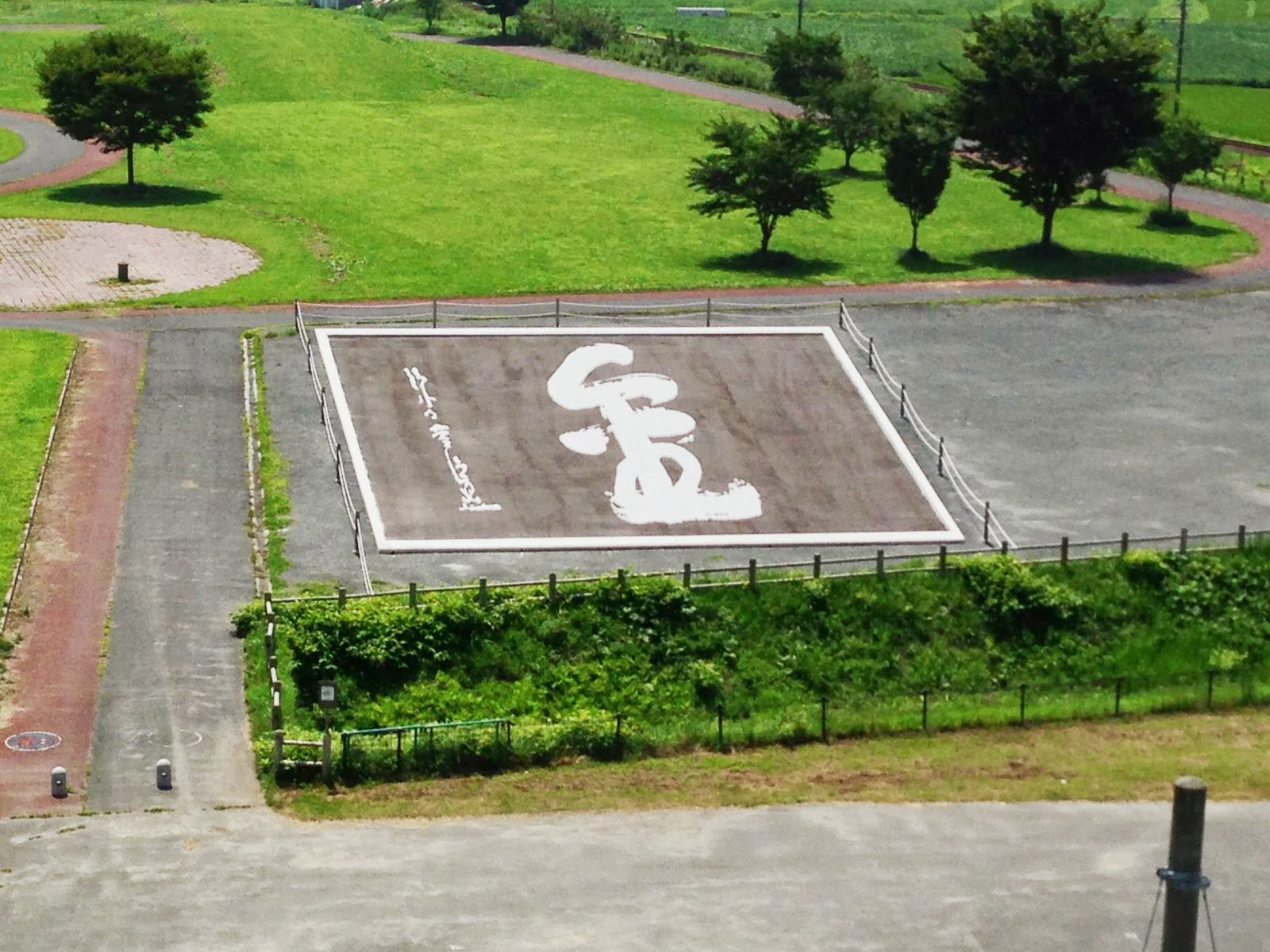
The reverse side - much more simple rice fields
the national kanji to symbolize 2012 - IKI  - as in life (or as in the draft
of draught beer... same same perhaps)
A colour test patch
And at the local govt. offices - a geisha
and Marilyn Monroe. 
Hiro was less than convinced by the comparison.