Monday, 23 August 2010

A typical breakfast


Breakfast from back left
Tofu with grated ginger,
Grated daikon,
Dipping Sauce (one on the opposite side as well)
Okra & tomatoes sauted with ponzu (citrus vinegar of sorts), basil, salt & pepper.
Miso eggplant
Chopped shallots
Chopped cucumbers
Somen noodles


Today's breakfast, a breakfast typical of our place, not of Japan.  Breakfast has evolved this way on account  of Hiro's late nights.  Neither of us feel like eating when he gets home after eleven ,   so breakfast has become the main meal with the most vegies and most nutrition.     This is a very quick meal.  

  • Tofu... 'scooped it out of the punnet' - (20 seconds including time to grate ginger),   
  • grate daikon - (perhaps a minute),  
  • dipping sauce - for summer dipping sauce I buy it ready made  and dilute with water /ice (30 seconds),  
  • okra & tomatoes (6-7 mins including chopping time) I made this last night though,  
  • miso eggplant (6-7 mins including chopping time), 
  • chopped cucumber (1 minute),  
  • somen noodles are boiled for 1 minute.  
  • shallots (1-2 minutes chopping) done last night.

Quick, easy and uses minimal heat in the kitchen.

Just a note (to placate my mother)  we do eat meat, not every day, but in a similar style of it being one of a number of dishes.  

Sunday, 22 August 2010

Some summer images


Rice in Tochigi getting close to harvest time

Sendai Tanabata Star Festival decorations in Shibuya
(even though Tanabata is usually celebrated on 7 July, in Sendai it's celebrated in early August.)

I think every Japanese home has a ceramic pig holder for mosquito coils.... why exactly... I'm not sure

Summer flowers in the mountains of Nagano
The Japan Alps of Nagano in summer - much of the year this road can't be traversed 


Fishing for goldfish at a summer festival. Goldfish are a traditional symbol of summer.


Pickled cucumber on sticks.  A summer treat.


Girls in  yukata - light and made of cotton yukata are perfect summer wear.

The tinkle of windchimes is said to make people feel cool.

An auspicious sign for older drivers?


Elderly driver sign to be changed to 4-leaf clover
Bending to the wishes of older drivers,  Japan has revised its  koreisha  mark,  which identifies 'older' drivers.  In 1997, Japan  introduced a system whereby drivers over 70 were asked to voluntarily display a mark on their car, much like a learner driver,  "in case their age affected their driving".   Drivers over 75 are theoretically obliged to display it.   In Australia, where at least among some people the mantra 'never ask a lady her age or her weight', prevails,  the very idea of publicly announcing one's age would be enough to cause great indignation, if not apoplexy.

In Japan, where people unashamedly ask people's age (to determine who is older and more senior in the relationship), the issue has not been about displaying the mark, but about the design of the mark.   The mark on the left - an autumn leaf - was the original design.  But the teardrop-esque shape was considered reminiscent of dying autumn leaf .... and resented by people in and approaching the 70+ age bracket.  The new design on the right is supposed to be a stylised four leaf clover that incorporates the letter S (for senior).... I hope it's auspicious, though no doubt the S = Senior will be lost on the majority of Japanese who are supposed to be displaying it.

Tuesday, 17 August 2010

Much has changed in 65 years

Yesterday (Sun 15th) commemoration services were held to mark the 65th anniversary of the end of World War Two.   The biggest is held at the Budokan in Kita no Maru park in Tokyo and is attended by the Emperor, PM, various politicians, government officials and  family members of former soldiers.   It's a solemn day with pledges all round (including from the Emperor)  that Japan is committed to peace and  war must not happen again.

In keeping with the spirit, as a conciliatory gesture, Prime Minister Kan declined to pay respects at the controversial Yasukuni shrine (more on that another time) *,  a  gesture  no doubt appreciated in China and Korea, where the stubborn visits of PM Koizumi in the mid 90s created a great deal of angst and escalated tensions. (see picture below)

Protests against Yasukuni visits in Hong Kong

 "Shame on Japanese Militarism"  1.

 The war commemoration followed Kan's  apology to Korea,  issued  the week before,  on the 100th anniversary of Japanese annexation of the Korean Peninsula.    It was the first time for Japan to apologise to Korea specifically, as well as the first time to acknowledge it was a  'forcible'  annexation.  The comments seem to be a reflection of his true beliefs more than engagement in realpolitik.   Much has changed in East Asia since the occupation of Korea and even the most right wing xenophobe would be prudent to  move with the times.


Japan, China, Manchuria, with co-operation
there will be great peace on earth (China
on the RHS, Manchuria on the LHS).


When Japan occupied  Korea and then Manchuria, arguably it was doing nothing different to what other colonial powers were doing at the time.   Actually, I raised an eyebrow last night at a 1932 news reel of Lord Lytton (the man charged by the League of Nations with investigating Japanese occupation of Manchuria)  speaking sternly about how Manchurians didn't want the Japanese ruling them  - I guess the irony  of British India and the 1930 Salt March was lost on him... but I digressed to a soap box....**

Japan in the 40s embraced the rhetoric of the 'Great East Asian Co-Prosperity Sphere'.   The picture on the right typifies the sentiment - happy China & happy Manchuria relying on responsible and noble Japan to lead them forward. 'The co-operation of Japan, China and Manchuria brings great peace to the world'.  In South East Asia the Japanese Imperial Forces boasted that they were liberating SEA from the yoke of European colonialism.   There was no question that anyone but Japan, the benevolent, would be in charge.


Japan 'liberating' South East Asia
The idea of an Asian prosperity sphere has never really gone away, even after the end of the War.

Walking around Tokyo these days, more than ever it feels that the idea of a genuine  Asian co-prosperity sphere is actually emerging, one that has co-dependence rather that exploitation as its core.


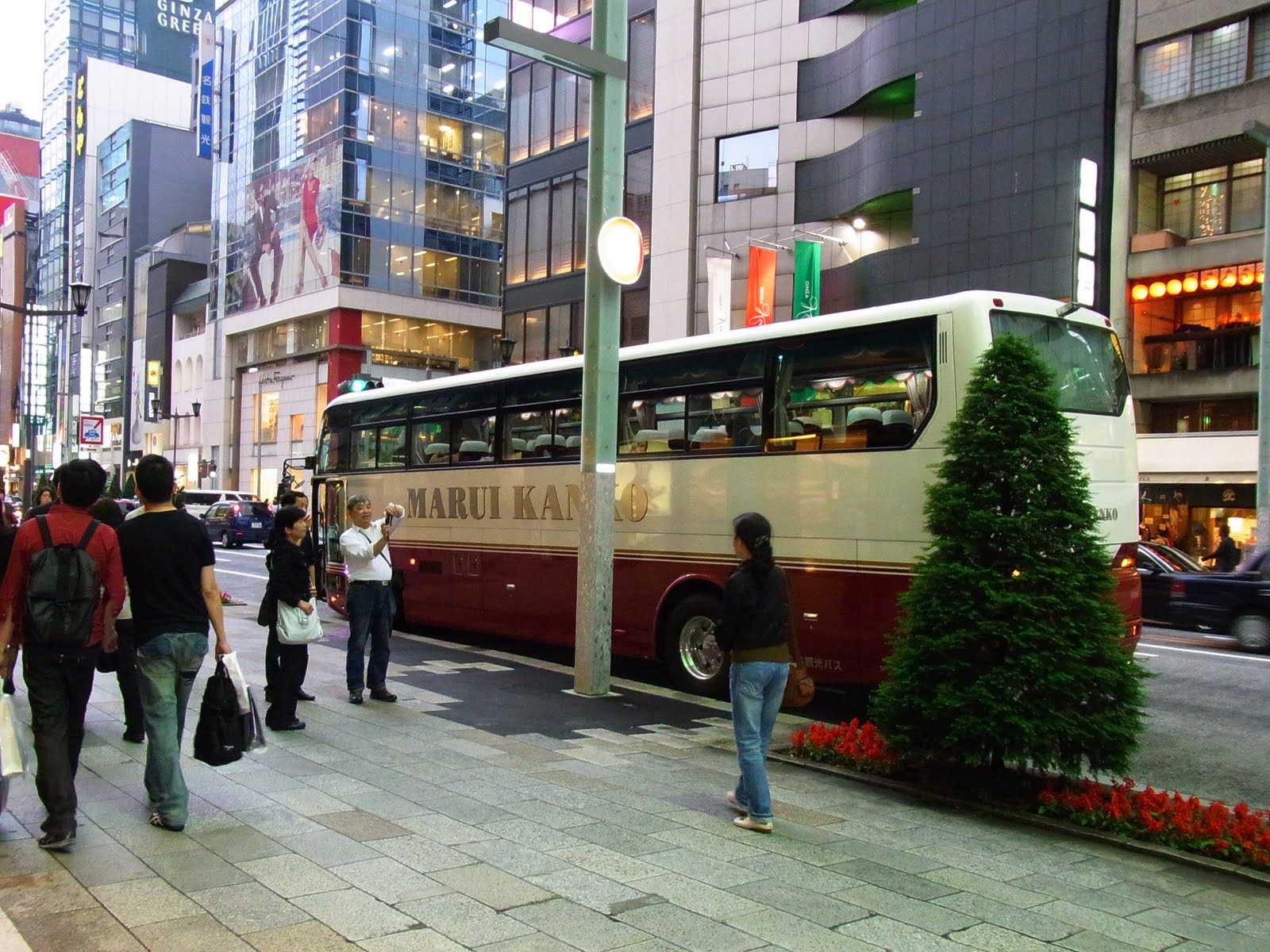
Mainland Chinese tourist sightseeing bus in Ginza
Restrictions on Mainland Chinese tourists have been relaxed, leading to an 80% increase in their numbers over the past year.  The last few times I have been to Ginza, the department stores  particular seem to have more Mandarin speakers shopping than Japanese and bus loads of tourists are coming and going.  Apparently the fact that designer labels in Japan are genuine, rather than fakes is a major drawcard.  All major shops that take credit cards are now accepting the Chinese Union Pay card.   Shops and hotels are starting to have Mandarin speaking staff.
Chinese tourists are moving beyond the cities to onsens. ski fields and historical. & religious sites.
The university where I teach is one of many that have started to offer  Mandarin as one of its second foreign languages.

Daikokuya Okachimachi with Union Pay
The economic relationship of even 5 years ago has shifted quite dramatically with Japan now providing services to Chinese consumers.  Chinese firms have also started to buy into Japanese companies, Yamada electronics a notable example.  There are more  skilled  Chinese workers in Japanese companies, and Chinese students (also Korean and SEAn) make a sizable part of the part time work force.

The changing situation has the potential to be good for both sides. Last week, to the dismay of many - particularly on the right,  it was announced that China has overtaken Japan as the world's second biggest economy, a logical development since China has close to ten times the population.  PM Kan makes a refreshing change from some of his belligerent predecessors, one can hope that goodwill can extend through out the region for better political relations to accompany changing economics.   One can also hope that closer contact will have the potential to stop Japan slipping further into economic malaise.
Union Pay - the Chinese credit card


Picture 1.  Anti Japan protests in HK following Koizumi's visit to Yasukuni  "Shame on Japanese Militarism"
http://www.chinadaily.com.cn/english/doc/2005-10/17/content_485604.htm
2. With the cooperation of Japan, China and Manchuria, there can be great peace on earth. (the flags are imperial China and Manchuria, Japan in the centre)
 http://www.chinadaily.com.cn/english/doc/2005-10/17/content_485604.htm
3.  Mighty Japan liberating SEA.***http://www.seasite.niu.edu/crossroads/aneher/warinsea_slbs.htm


* I'll write more about Yasukuni at some point in the future.  But in short, it's a Shinto Shrine in central Tokyo where the souls of all soldiers who died fighting for Japan are enshrined (whether or not they want to be).  This includes war criminals who were specifically enshrined in ceremonies in 1959 and 1978.
**  I am not a  Japanese right winger in disguise as a foreigner, but I still find this quite ironic.