I like rules. Good rules make for a peaceful harmonious society.
Take for example the rule here that people shouldn't talk on a mobile phone on a train, in a library or other place where it might cause irritation to the general public who isn't at all interested in the trite mundanities of a stranger's life. The rule makes train travel so much more pleasant. There is also a rule that it's ok for children to stand on seats on the train, but they should take off their shoes. It keeps children happy that they can look out the window and at the shinkansen hurtling past, and at the same time it keeps seats cleaner and less susceptible to wear.
A rule that said any political campaign vehicles have to have their loud speakers set to 60 decibels or less would definitely be a good rule, dramatically improving quality of life during election campaings.
Some rules however are are just dumb: ill conceived,unreasonable and very irritating...
Some recent examples....
My work rules:
- non full time teachers may not use university computers, including for work related matters.
- non full time teachers must not keep anything beyond what fits in a 15cm deep, A4 size drawer at the university
- teachers must keep exam papers of students (two semesters) for one year after the test has been done, but the exam papers must not be kept at the university...
- teachers must dispose of exam papers in a way that maintains the privacy of students, but teachers are not allowed to use the university shredder.
Hiro's work rule
- starting times are staggered - either 9 am or 9.30 am - but starting earlier doesn't mean your finishing time is earlier.
- a person going on a business trip by plane may not go to the destination early or return later
even if it is a weekend and using their own time. For example if there is a meeting in Kagoshima (south of Kyushu island) at 10am, the employee alsmost always has to get up super early to be on the first plane of the morning to get to the meeting on time. Going to Kagoshima, on Sat, spending a leisurely weekend and being bright fresh to go to the meeting on Mon. morning, is not permitted - because the rule is that if you are enjoying yourself it might be a junket - even though you are paying your own accommodation. . If a business trip ends on a Friday afternoon, the return plane ticket must also be on the Friday. And yet the rule also says if there is an overseas trip like to S America - an employee will go on Sat, will arrive back Sun, will go to work Mon, and will not get time off in lieu.
- workers cannot keep frequent flier points for work related travel, but at the same time, they don't
save them for the company's use either...
Thursday, 13 May 2010


Friday, 7 May 2010
Biking home
Up early to beat the traffic... we left on Wed am. It was a 640km or so in 10 hours including breaks - a break every 80kms or so makes for much more comfortable bike travel. Mostly the traffic flowed well.
This is a picture of Mt Iwate from the Iwate san petrol / rest stop a bit over 100kms from Odate.

The coast road - Tsugaru peninsula
From Shirakami sanchi we continued north. There is a an alpine road that goes east towards Hirosaki but it's only traversable in the late spring and summer. The road we took follows the coastline closely much of the way to the tip of the Tsugaru peninsula. In parts it is a very thin strip between the coast and the mountains and much concrete has been used to reinforce the escarpments / embankments to prevent landslides. The road along the coastal strip was notable for the lack of convenience stores, lack of pachinko parlours and lack of conspicuous? temples and shrines. * Once we were north of the rice growing area, the main industry seemed to be squid fishing and selling. Lots of shops selling yaki-squid, with squid hung out on drying racks next door.

Looking north from the top of Akita prefecture. The black soil seemed to be natural and not the result of any immediate pollution.... That said though, Japan Sea coast gets a lot of debris washed up - that which doesn't originate locally is mostly from Korea, Russia and China.

Looking south down the coast. The land behind is steep, the precipitation high making the area vulnerable to landslides and in need of reinforcement.

Very pretty coastline, the Gono line railway runs parallel to the road several metres away. The escarpment or should that be embankment next to the road is a concrete grid to stop landslides. There is an awful lot of concrete used along the coast in particular, but also in general. Dogs and Demons, a contraversial and perhaps cynical book written by an American in Japan, is a detailed expose of the motivation for concreting and public works.

Rice fields next to the sea

Squid boats - identifiable as squid boats by the lanterns on the side - squid are attracted to light.
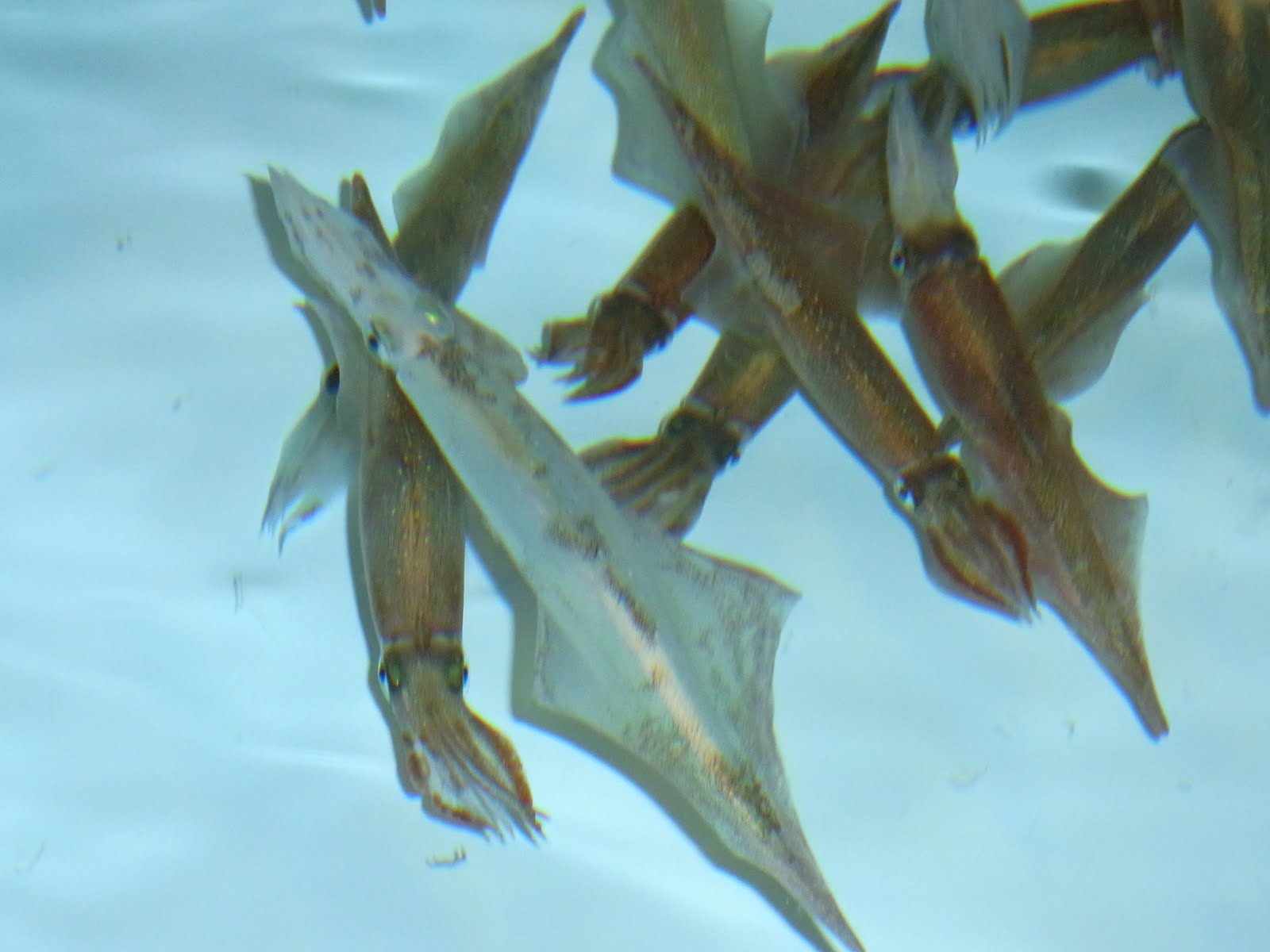
Squid in a fish tank at a tourist information / rest centre

Bense Wetlands - Apparently this kind of wetland is unusual in its close proximitiy to the beach. Clicking on the link will take you to summer pictures that are more impressive. Winter is only just over on the Tsugaru peninsula. Much of the area around here is used for greenhouse melon and strawberry cultivation.

Cape Tappi - the northern most point of Tsugaru hanto (peninsula).
There has to be a t-shirt in this!
* Tsugaru does have a major shrine - Takayama inari jinja - but I left my camera in the car.... It attracts donations from nearby prefectures as well as locally, mostly from people who are wanting good fortune in their business... judging by the state of northern Tohoku's economy I wonder at its efficacy...
Shirakami Sanchi
 A trip to the onsen, and early night and we woke bright and early to Hiro's mother's breakfast mostly on the table. Mountain vegetable picking season has begun and we feasted on local foods that aren't found in Tokyo..... I really should have made a better note of them...Mountain veges can be quite bitter, but prepared well they are a treat.
Shirakami Sanchi is pristine beech forest, and without doubt the most natural nature i have seen in Japan. It is also Tohoku's only UNESCO World Heritage site. It's somewhere I have been wanting to go for years, but had only made it as far as the visitor centre on a cold and wet day on a trip back from Hirosaki.... Looking at pictures of trees isn't really the same as walking through them.
We took a back road to avoid holiday traffic, and passed through countryside, where the roads were straight and the farming paddocks large. Quite unusual in most of Japan - and indicates relatively recent agricultural settlement. Traditionally most roads in the countryside are narrow and windy and trace the edge of rice paddy borders and rivers. I assumed it was because the winters there are so severe - utterly vile in fact. Blizzards, snow, blizzards, snow, inaccessible roads... Much of the the 1800mm or so rainfall each year comes in blizzards.... According to Hiro that's unlikely to be the reason - much of the settled parts of the Japan Sea coast have similarly severe winter - rather it was more to do with lack of a year round water source to enable rice cultivation.
Possibly in the past it was an area inhabited by semi-settled bear hunting clans.
We took the turn off the coast road to Juuni ko (12 lakes) though actually there are more than 30 lakes there...It was really pretty. Much of Tohoku used to be beech trees - their leaves are cope well with heavy snow falls - but cedar trees, the staple of the plantation industry, now dominate. Shirakami sanchi area was too remote, too inhospitable, and too far from a port to make planations feasible. Surprisingly though the beech tree forest is only 800 years old, a product of the thawing of the last mini ice age.
I would like to go back in different seasons, in part because it looks remarkably different depending on season, and in part because the Shirakami skyline road was still untrafficable due to snow making it impractical to go through to the other side of the forest. This is a link to a video made by Japan's national broadcaster, NHK, showing the park at different times of the year. http://whc.unesco.org/en/list/663/video

One of the Juuniko lakes

Aoike (the blue lake... rather aptly named)

Beech forest of shirakami coming into spring

Beech forest of shirakami

We were lucky enough to see a wild monkey! It had no fear of humans at all. It stayed there quite happily, aware that there were people there. In more heavily touristed areas / areas closer to human settlement monkeys can become very unpleasantly aggressive in demanding food.

A lake

Better not miss the bus! Train connection information is indicated in the right hand column.
http://konanbus.com/juniko/juniko.html The bus timetable on the Konan Bus company website.
http://matiasstella.com/2009/10/22/shirakami-sanchi.html a blog with beautiful autumn pictures of shirakami
http://www.weather-forecast.com/locations/Aomori reference for the map
Subscribe to:
Posts (Atom)